
Bunkers: reading them on the map and when to play safe
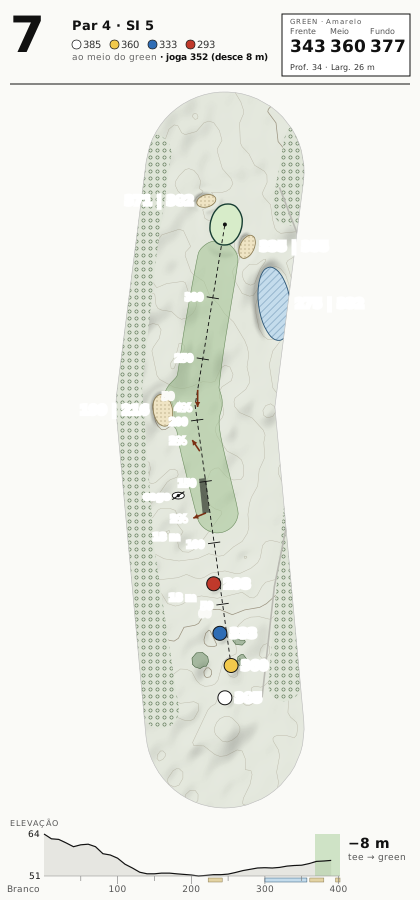
In a yardage book a bunker is more than a patch of sand. The two numbers beside it tell you exactly what the shot has to do.
In short
The two numbers beside a bunker say where the sand starts and what it takes to carry it. Compare the carry with your normal shot, not your best; when in doubt, lay up or aim away.
What the numbers say
Beside each bunker are two numbers, measured from the tee: where the sand starts and where it ends. On hole 7 of our sample, the bunker on the left reads "199 | 216":
- a ball that stops before 199 m stays short of the sand;
- to fly over it, the ball must carry at least 216 m.
The first number is for laying up; the second, for carrying. The trouble lies in between.
Carry it or lay up?
The question is not "can I carry it?" but "do I carry it comfortably, even with a less than perfect strike?". A rule of thumb: compare the carry with how far your shot flies when it is not your best, not with your longest of the day.
- Comfortable carry: go over and use the fairway beyond the bunker.
- Just about: take a club that finishes short of the first number, or aim away from the bunker.
- Out of reach: lay up, leaving room for the ball to run.
Allow for the ground too. Uphill the ball flies less; downhill, more. Uphill and downhill.
Fairway bunkers and greenside bunkers
Fairway bunkers shape the tee shot: you can usually avoid them with the right club or the right side of the fairway. Greenside bunkers shape the approach. On hole 7 there is one front right of the green (335 | 355) and another back left (371 | 382).
The green page shows where they sit relative to the flag. A flag just behind a bunker asks you to aim at the middle of the green, not at the flag.
The safe side
Before each shot, look on the map for the side where a miss costs least. With a bunker on the left and a lake on the right, the water is almost always the bigger risk: from a bunker you still play; from the water you lose a stroke.
In short
- First number: where the sand starts. Second: what it takes to carry it.
- Compare with your normal shot, not your best.
- When in doubt, lay up or aim away.
- Near the green, aim for the middle when the flag is behind a bunker.