
Plays longer, plays shorter: uphill and downhill
Map distances are measured on the flat. The ball rises and falls with the ground, and that changes the right club.
In short
Each metre of elevation is worth roughly a metre of distance: downhill, less club; uphill, more club. It is an approximation: with big drops, wind or altitude the effect changes.
Why elevation matters
A ball landing on a green below the point it was struck from stays in the air longer and travels further. Uphill the opposite happens: the green comes earlier in the flight and the ball comes up short.
The rule of thumb
Many golfers and yardage books use a simple sum: each metre of elevation is worth roughly a metre of distance.
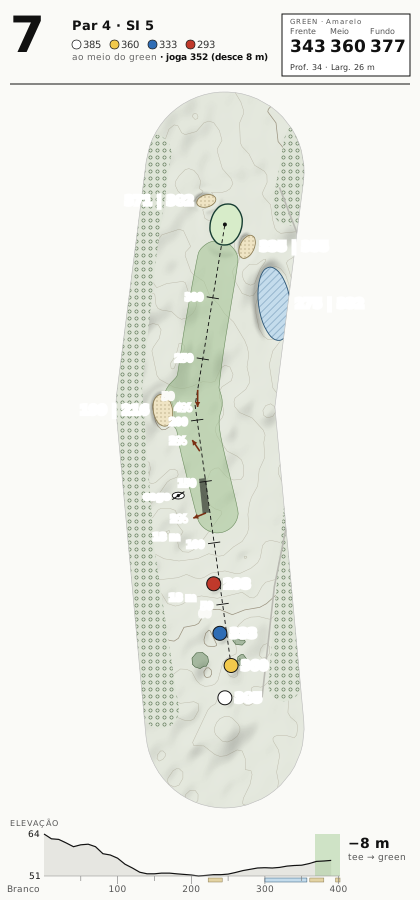
- Down 8 m to a green 360 m away, the hole plays about 352 m.
- Up 10 m to a flag 140 m away, the shot plays about 150 m.
It is an approximation, not a law. With big drops, wind or altitude the effect changes, and every player should fine-tune it with experience.
Where to see the elevation
From the tee, the eye deceives: a green at the bottom of a slope looks closer than it is, and a raised green hides the flag. In a yardage book, the elevation profile shows the ground along the hole and the header says how long it plays. On hole 7 of our sample: "plays 352 (8 m down)".
It counts on the green too
The same goes for putts. Uphill needs more pace and breaks less; downhill, the opposite. How to read a green.
In short
- Downhill: less club.
- Uphill: more club.
- A metre of elevation is worth about a metre of distance.
- Trust the hole profile more than what the eye sees from the tee.